
A product’s design is often its first impression; and sometimes, it’s the strongest competitive edge. Before filing for a design patent, it’s essential to confirm that your design is truly original and not already protected somewhere in the world. That’s where a Design Patent Search becomes invaluable.
In a space where even a minor resemblance to an existing design can trigger rejections, disputes, or lost production time, understanding what’s already out there is critical. A well-executed design search goes beyond matching shapes; it uncovers visual similarities across global design databases, utility patent drawings, product archives, e-commerce listings, and even prototype disclosures, ensuring your design stands on solid ground.
At Ingenious e-Brain, we combine structured database searches with unconventional strategies to uncover prior art often missed in traditional searches. Our approach blends advanced image-based search tools, expert classification analysis, and extensive global coverage to help innovators file confidently and safeguard their design aesthetics.
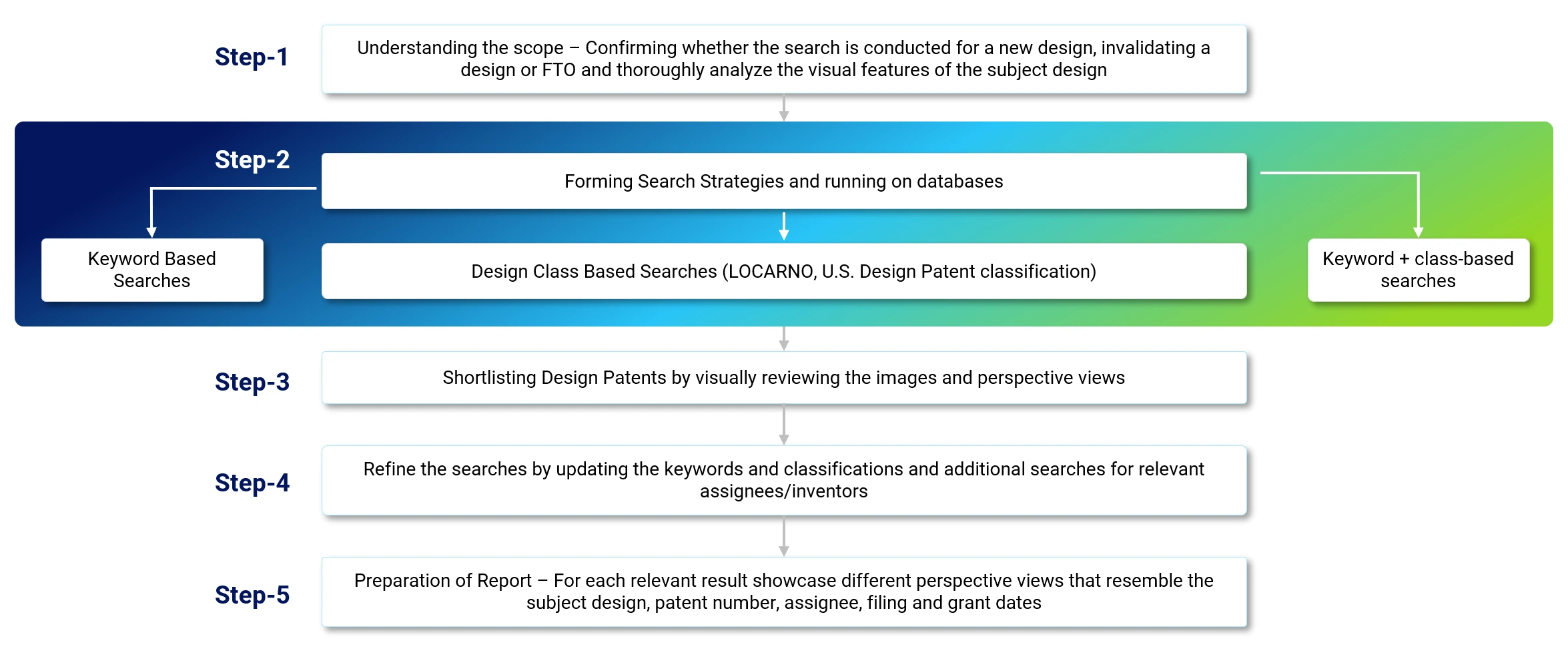
The approach begins with a close reading of the disclosed design—its drawings, views, proportions, and ornamental cues. This helps define the search intent (new design assessment, invalidation, or FTO) and sets clear boundaries around what needs to be compared during the search.
With the visual scope understood, key design features and parameters are identified, further guiding the creation of a structured search approach that blends strong keyword planning with appropriate Locarno, U.S. design classes, and other jurisdiction-specific classifications. Searches around the keyword, keyword + class, and design class are then initiated across global design databases, such as Orbit Design, Google Patents, and WIPO’s Global Design Database.
All retrieved references—patent and non-patent—are screened visually. Perspective views, images, and ornamental elements are compared to shortlist designs that exhibit meaningful similarity. This helps filter down to designs that deserve deeper analysis.
Searches are further refined by revisiting keywords, updating classes, and expanding the exploration toward non-traditional sources. This may include:
• Utility patent drawings
• Product listings, e-commerce platforms, and review sites
• Prototype catalogues and historical product variants
• Manufacturer or region-specific design archives
All relevant results are analyzed and mapped across different views in the report to evaluate levels of similarity—identical, highly similar, or related. The final report highlights these references with supporting visuals and their bibliographic details, including assignee, inventor, filing information, and grant status.

Maßgeschneiderte Preismodelle und schnelle Bearbeitungszeiten für jedes Budget und jede Projektanforderung

Pay only when you're fully satisfied—our commitment to delivering quality you can trust

Über 120 Doktoren und Fachexperten aus den Bereichen Ingenieurwesen, IKT, Biowissenschaften und neue Technologien

Comprehensive patent and non-patent literature from 100+ countries in multiple technology areas covered across 15+ databases

Native language capabilities in 25+ countries, including CN, JP, and KR, with regional database coverage for accurate native language search results

Austauschbare, leicht verständliche Berichte mit Anspruchselement-Grid-Mapping zur Beschleunigung Ihrer Entscheidungen

Hybrid search approach combining Artificial Intelligence + Human Intelligence to deliver accurate, relevant results

Suchteams in den USA und Indien, unterstützt durch etablierte Prozesse zur Einhaltung der Exportkontrollvorschriften

Mehrstufige Firewalls und strenge Zugriffsprotokolle zur Gewährleistung vollständiger Datenvertraulichkeit und Compliance


Unsere Dienstleistungen sind darauf ausgelegt, Unternehmen in den unten genannten Branchen und Sektoren zu unterstützen und ihnen dabei zu helfen, ihre strategischen Ziele zu erreichen.
A design patent search examines existing design and utility patents, published applications, product archives, and other public references to determine whether a design is original, novel, and eligible for protection.
It helps identify similar or identical designs that could lead to rejection, infringement risks, or delays. A thorough search reduces uncertainty before filing and supports stronger protection strategies.
Searches cover global design patent databases, utility patent drawings, WIPO and national patent databases, design registries, product review sites, prototypes, manufacturer catalogs, and image-based archives.
No. Utility patent drawings, product designs, concept art, and other visual disclosures are also reviewed, as they may serve as valid prior art for a design.
The methodology integrates classification-, keyword-, citation-, image-, and native-language searches, supported by expert analysis to ensure thoroughness and accuracy.
Yes. The report includes a structured assessment of similarity and an overall evaluation of the design’s distinctiveness based on identified prior art.
Absolutely. The methodology supports a range of sectors, including electronics, wearables, industrial products, consumer goods, medical devices, automotive components, and more.