
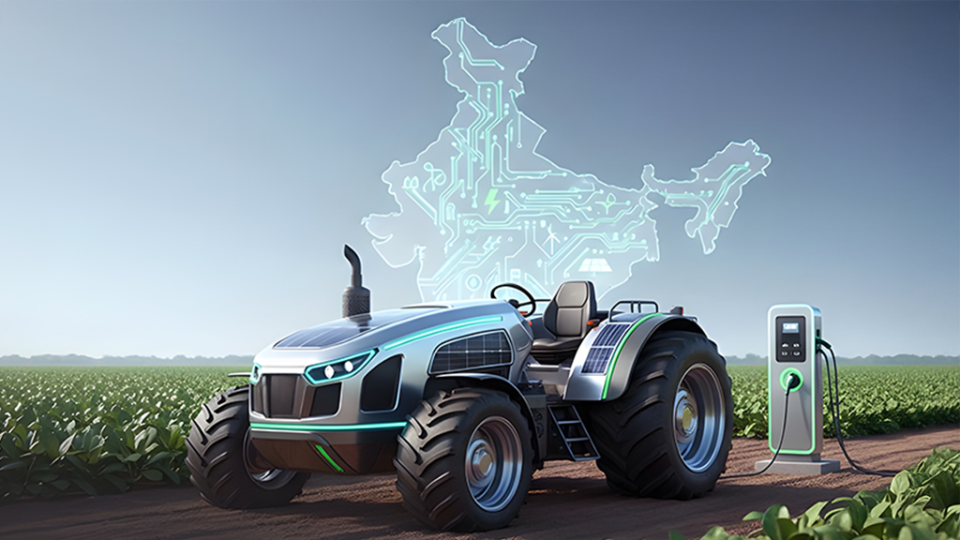
India’s agricultural mobility sector is undergoing a significant shift as electrification gains momentum across rural markets. Rising fuel costs, growing interest in sustainable farm practices, and improving access to clean energy are pushing the electric tractor segment from a niche curiosity into a realistic alternative for future farm operations. As emissions policies tighten and the trend toward greener mechanization is accelerating, OEMs are rethinking their long-term product strategy and exploring where electric tractors can have a meaningful impact.
Barriers That Continue to Challenge Electric Tractor Push
Yet even with all the excitement around electric tractors, several structural challenges continue to slow adoption. Farmers still trust the proven power, durability, and all-day performance of ICE tractors, making it difficult for electric models to earn the same level of confidence. Charging remains inconsistent across rural belts, and the absence of fast-charging or battery-swapping networks adds uncertainty to long-duration fieldwork. Upfront cost sensitivity, limited availability of EV-trained service technicians, and questions about battery lifecycle further complicate decision-making. These gaps don’t diminish the potential of the electric tractor but underline the need for a clear, insight-led strategy before investing heavily in the space.
Turning Electric Tractor Market Uncertainty into Strategic Advantage
To unlock this opportunity, companies must ground their decisions in a holistic and data-backed market strategy. This means identifying the most promising regional clusters where electric tractors can gain early traction, understanding evolving customer needs, and benchmarking competitors to uncover meaningful differentiation. It also requires a deep understanding of the policy environment, evaluating incentive structures, and assessing where government support can significantly accelerate adoption. As the supporting ecosystem, which includes charging networks, renewable energy availability, and tech partnerships, continues to mature, aligning product development and commercialization efforts becomes essential.
A well-defined approach not only helps navigate market uncertainty but also strengthens positioning in a segment set to scale rapidly.
Get an inside look at how we guided our client through the opportunities, challenges, and competitive nuances while establishing a strong foothold in India’s fast-evolving electric tractor space.
Download the complete case study by completing the form.


