

An innovation is considered successful only when it solves real-world problems. But turning every idea into a useful product or technology isn’t a straightforward approach. The process involves addressing legal and business realities shaped by existing intellectual property rights before any product or technology is built, scaled, or commercialized. This is where a Freedom-to-Operate (FTO) search becomes crucial.
An FTO search is an organized process to assess whether it is possible to develop or license your product or technology without infringing on patents in specific regions. It is essential to clarify this misconception. FTO is not about whether or not your invention is patentable. Instead, it is more about: Is it possible that someone else owns legally enforceable rights that create an obstacle in your way?
At its core, an FTO search protects innovation from avoidable legal risk. It helps organizations understand where potential patent conflicts may arise, how serious those risks are, and what options exist to move forward. Apart from safeguarding, an FTO analysis is useful in supporting R&D processes.
Importantly, FTO (Freedom to Operate) is not a one-time assessment; it’s an ongoing process that must keep pace with a constantly evolving patent landscape. As products continue to innovate, new patents are issued, markets expand, and competitors become more inventive, the risk profile shifts. This makes regular reassessment essential to ensure continued freedom to commercialize without infringing on third-party IP rights.
How Crucial Is an FTO Search?
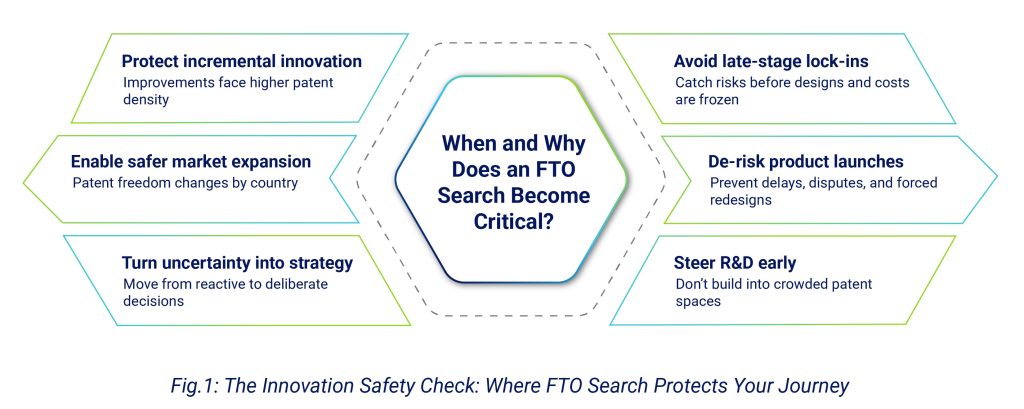
Many organizations delay doing FTO analysis until late in development, often when a product is already far down the road to market. By that time, key design decisions are locked in, investments have been made, and flexibility is limited. Understanding when and why an FTO search is needed helps organizations avoid getting trapped in that situation.
Before Product Launch or Market Entry
One of the most common triggers to initiate an FTO search is an upcoming product launch. At this point, infringement risks have real consequences: litigation, injunctions, or unexpected licensing demands can delay market entry, erode margins, or force costly redesigns.
In this scenario, the FTO search helps identify existing active patents that could affect the product. This allows businesses to assess the risk of patent infringement, decide if any design changes are needed, and plan when to initiate licensing discussions. This clarity gives confidence in the go-to-market plan and significantly reduces the chance of last-minute disruptions.
Introduction During the Development of New or Improved Technology
FTO is equally crucial earlier in the innovation cycle. At the stage of development, an FTO search can have an active impact on the technical direction. If some features appear heavily patented, R&D teams could adopt other approaches to avoid crowded patent spaces.
This is even more important for improved or incremental innovations. Improvements are often based on existing technologies, which are therefore more likely to be encircled by active patents. Early FTO review ensures that development efforts remain focused on solutions that can actually be deployed in the market.
When Expanding into New Markets or Jurisdictions
Freedom-to-operate (FTO) analysis is inherently jurisdiction-specific, as patent rights and regulatory frameworks vary geographically. A product permitted in one country may face IP restrictions in another. Therefore, innovators or companies must conduct comprehensive FTO assessments tailored to each target market before expansion.
Patent scope, enforcement criteria, and legal interpretations vary widely across countries. Performing an FTO search in each target jurisdiction will help make expansion plans both realistic and legally viable. This allows a company to screen markets based on risk, opportunity, and overall cost of entry.
Across all these scenarios, the real value of freedom to operate search lies in its ability to support strategic decision-making. It transforms uncertainty into structured insight and allows organizations to act deliberately rather than defensively.
How to Start Outlining Your FTO Strategy
A good FTO search is always built on a sound strategy. Searches performed without proper scoping can easily become too narrow to be helpful or too broad to be practical. Thoughtful planning ensures the FTO effort supports business goals, technical realities, and acceptable risk levels.
Technical Aspects Evaluation
First, understanding the innovation’s technical maturity. The stage of development matters since patent claims intersect with technology differently, depending on how clearly the product is defined.
Early-stage concepts are broad and flexible, whereas at a later stage, products come with fixed features and specifications. As the product evolves, the relevant patent landscape is also extended. Claims that were previously irrelevant can become critical.
When the products represent an improvement or modification of prior technologies, FTO searches will need to consider both the base technology and improvements. Just because a foundational patent may have expired, related refinements or alternative embodiments, or even downstream innovations, may still be covered by an active patent. Assuming freedom solely based on expiration is one of the most common and expensive mistakes.
Clear technical documentation is essential at this stage. Defining core features, optional variations, and intended use cases ensures that the FTO search accurately reflects what will be commercialized.
Level of involvement and R&D investment
The depth of an FTO search should be proportional to the level of commitment made to technology. A small exploratory project does not require the same level of analysis as a product approaching full-scale commercialization.
Organizations should consider:
- Is the work exploratory research, a prototype, or a near-market product?
- Are there any external partners or investors?
- Are approvals necessary from authorities?
Generally, the more significant the R&D investment, the greater the confidence required in freedom-to-operate. As the financial, reputational, and operational stakes rise, the cost of getting something wrong grows exponentially.
At the same time, FTO searches should not extend beyond the point of diminishing return. It is not practical to search for every conceivable patent worldwide.
Technologies with lower investment or limited revenue potential may justify a narrow search.
The goal is balance. A well-calibrated FTO search aligns scope and intensity with investment level, risk exposure, and business objectives, delivering meaningful insight without unnecessary complexity.
Comprehensive Analysis of Your Industry
The next step in developing an effective Freedom-to-Operate (FTO) strategy requires a thorough industry analysis and tailored approach, as patent landscapes vary significantly across fields.
Also, expertise in industry-specific patenting practices is crucial, given the high level of competition in certain sectors. Monitoring industry trends, such as key patent holders, leading innovators, and emerging technological domains, provides vital insights for interpreting FTO results. This understanding helps determine whether the technology landscape is relatively stable or rapidly evolving, guiding strategic decision-making and risk mitigation.
Market regions have their own importance as well. Companies must define in clear terms in which countries they will manufacture, sell, or license their products. Each of these activities poses infringement risks. There is a need for customized FTO searches in countries of prime importance.
With technical, investment, and industry expertise, companies can formulate an FTO strategy that is focused, relevant, and action-oriented.
Selecting the Partner to Conduct the FTO Search
Selecting an external partner for FTO (Freedom-to-Operate) search is crucial. Although preliminary analysis can be done internally, detailed FTO analysis typically requires specialized expertise from a qualified third-party provider. The choice of partner significantly influences the accuracy, thoroughness, and defensibility of the FTO findings, thereby impacting subsequent patent clearance and commercialization efforts.
Technical and Legal Expertise
A good FTO search combines technology and law. The partner needs to have sufficient knowledge of the subject matter of technology to interpret a patent claim correctly. They should have a sufficient understanding of the law to determine enforceability.
Domain-specific expertise is significant. Patent language can be highly nuanced, and misinterpreting a claim can lead to false confidence or unnecessary concern.
Global Coverage Capabilities: Patents
As patents are jurisdiction-based, global coverage is essential for businesses operating internationally. Therefore, an apt FTO partner must provide access to global patent databases and precisely identify potential patent risks across multiple jurisdictions, ensuring thorough coverage and legal protection.
Effective Methodology and Transparency
FTO searches follow a systematic approach that includes detailed product feature analysis, categorization, keyword searches, and claim mapping. This structured methodology ensures accuracy and completeness in identifying relevant patents.
Transparency is a consideration that cannot be overlooked. In consensus, it is essential for clients to have a complete understanding of how a search was conducted and where limitations exist.
Additionally, transparency in the search process—clarifying scope, limitations, and assumptions—is crucial for building client confidence and supporting strategic decision-making.
Actionable & Clear Insights
The value of an FTO search lies not just in identifying risks, but in explaining them clearly. There should be a distinction between the level of possible danger identified through the search, which includes low, medium, or high.
A good partner will speak in simple terms, relate findings to implications for the company, and assist in decision-making without overwhelming stakeholders with raw data.
How We Can Be Your Potential IP Partner in Your Innovation Journey
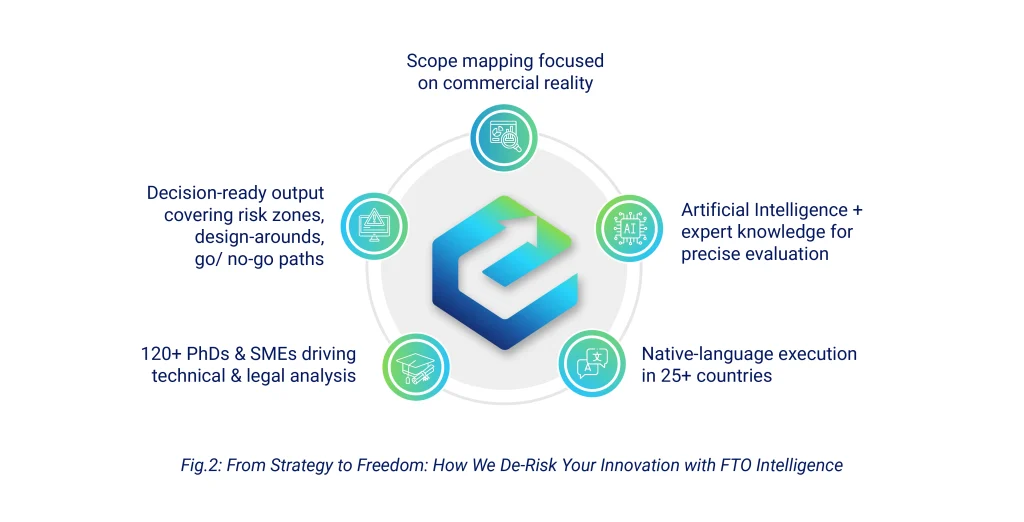
When it comes to choosing an FTO partner, trust is the deciding factor, and the knowledge & experience of our cross-domain experts ensure you get clear, reliable guidance. Our commitment to technical accuracy, legal relevance, global insights, and clear presentation aligns perfectly with your expectations. By translating your strategy into a systematic, in-depth process tailored to your goals, risk tolerance, and target markets, we empower you to achieve confident, effective outcomes.
Clear Definition of Scope, Emphasizing Commercial Reality
In building our understanding of the product as it will be commercialized, including its features, possible variants, and markets, we ensure our FTO search focuses on practical applications in the real world, ensuring we check for legal issues relevant to actual market use, not just technical details.
International and Multi-Lingual Search Facility
Freedom-to-operate risks are often embedded in local patent filings. By conducting searches across major jurisdictions with native-language capabilities in over 25 countries, accuracy improves, and reliance on machine-generated translations is reduced, especially in regions where early filings may not be available in English.
Focused Analysis with Business Context
Analyzed patents are compared against specific product features to determine true exposure. This is a relevance analysis that separates true risk exposure from risks unlikely to impact commercialization.
Action-Oriented Reporting
Findings are also presented in ways that are structured and simple to review so that critical risks can be noted. Feature-based summaries and risk prioritization ensure that teams immediately understand the area of focus and available options.
Through alignment with commercial goals, we ensure that innovative teams effectively balance patent risk with momentum to enter the market.
Conclusion
Freedom-to-Operate search is a critical component for every organization serious about innovation and commercialization. By helping alleviate legal uncertainties during strategic planning, these searches can prevent legal issues from becoming impractical hurdles.
Ready to turn FTO from a legal checkpoint into a strategic advantage for your innovation journey? Talk to our seasoned IP experts by filling out the form below or emailing us at contact@iebrain.com.