Quantum computing is steadily emerging as a transformative enabler across the automotive ecosystem, moving from theoretical research into early-stage industrial exploration. This shift is being driven by increasing complexity in electrified, software-defined, and highly autonomous vehicle systems.
This article maps the evolving quantum computing landscape, including its role in automotive, global market trends, key ecosystem players, early OEM and technology collaborations, and recent developments in battery-focused applications, along with the long-term outlook for the industry.
What is the role of quantum computing in the automotive industry?
As vehicles evolve into software-defined, electrified, and highly autonomous systems, traditional computing approaches are increasingly constrained by scale and complexity.
Quantum computing introduces a fundamentally different model of computation, leveraging quantum mechanical phenomena such as superposition and entanglement. This allows multiple computational states to be evaluated simultaneously, making it particularly relevant for high-dimensional problems such as battery chemistry simulation, materials discovery, and optimization of autonomous systems.
In automotive, the technology is not about replacing classical computing but augmenting it for specialized, computation-heavy use cases.
How is the quantum computing market evolving globally?
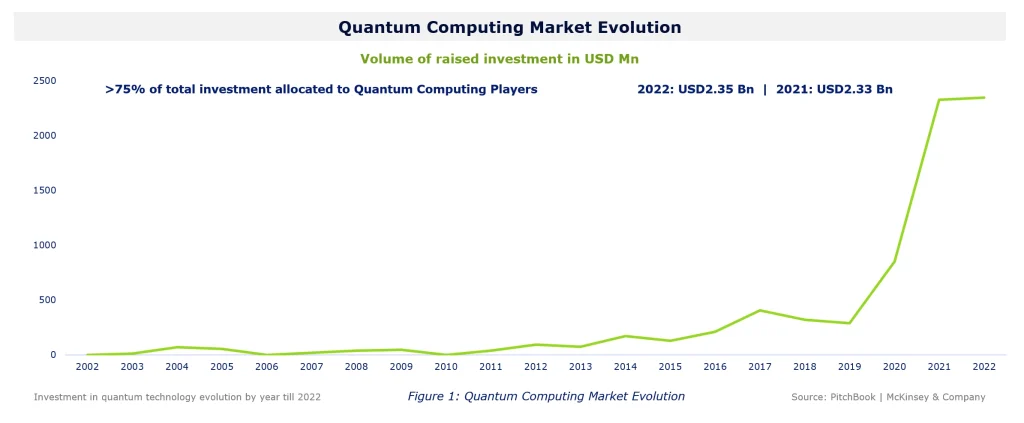
The quantum computing market has moved from early-stage research to a rapidly accelerating investment phase over the past decade, as reflected in the sharp rise in funding activity after 2018.
For most of the early 2000s and mid-2010s, investment levels remained relatively modest, driven largely by foundational research in quantum mechanics and prototype development. However, the landscape began shifting significantly as cloud-based quantum platforms emerged and industry participation increased.
From around 2018 onward, the market entered a high-growth phase, marked by a steep surge in global investments. This culminates in a major jump in funding in recent years, with total investment reaching multi-billion-dollar levels (over USD 2.3Bn in 2021–2022), indicating strong investor confidence in quantum technologies.
Today, more than 75% of quantum computing investments are concentrated among leading players, highlighting a highly focused and capital-intensive ecosystem.
The following characteristics define the current phase:
- Rapid acceleration in private and government funding.
- Strong consolidation of investments among key quantum players.
- Increasing commercialization efforts across sectors such as automotive, pharmaceuticals, and logistics.
- Growing transition from experimental systems to early real-world applications.
While large-scale quantum advantage is still evolving, the investment trajectory clearly shows a shift from exploration to industrialization, with quantum computing steadily moving toward practical deployment at scale.
Who are the key players in the quantum computing value chain ecosystem?
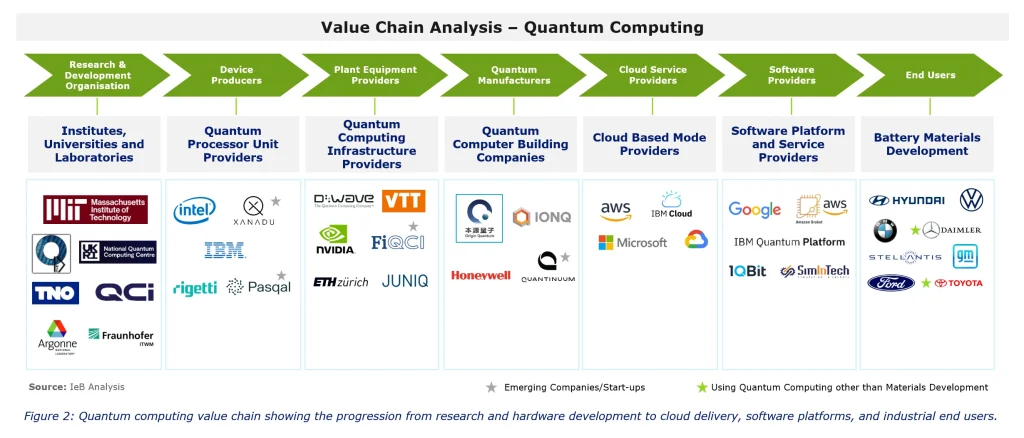
Quantum computing is evolving through a layered ecosystem that connects research institutions, hardware developers, cloud platforms, software vendors, and industrial end users. The infographic below maps that value chain and shows how each layer contributes to turning quantum research into practical business applications, especially in areas like advanced materials, automotive innovation, and battery development.
At the foundation of the ecosystem are universities, laboratories, and research organizations such as MIT, National Quantum Computing Centre, TNO, QCI, Argonne National Laboratory, and Fraunhofer ITWM, which develop the scientific principles, algorithms, and experimental methods behind quantum computing. These institutions help build the technical base that supports the rest of the industry.
Above that sit hardware and device providers including Intel, Xanadu, IBM, Pasqal, and Rigetti, along with infrastructure providers such as D-Wave, VTT, NVIDIA, FiQCI, ETH Zürich, and JUNIQ. Together, these companies are building quantum processors, supporting infrastructure, and the specialized equipment needed to make quantum systems operational at scale.
The next layers include quantum computer manufacturers such as Quantinuum, IonQ, Origin Quantum, and Honeywell, as well as cloud service providers like Microsoft, AWS, Google, and IBM Cloud. On the software side, platforms and service providers such as Amazon Braket, IBM Quantum Platform, 1QBit, and SimInTech make quantum capability more accessible to enterprises through hosted environments and application-ready tools.
For end users, the most immediate opportunities are in domains where simulation and optimization are especially difficult for classical computing, such as battery materials development. The infographic highlights companies such as Hyundai, GM, Ford, BMW, Volkswagen, Stellantis, Daimler, and Toyota as examples of industrial players exploring quantum computing for future materials and mobility applications. In other words, the infographic is not just showing a technology stack—it is showing the path from scientific discovery to commercial impact.
How are startups and tech giants shaping the quantum computing landscape?
Startups and large technology companies drive the development of the quantum computing ecosystem as complementary forces.
Startups are driving innovation at the frontier, focusing on qubit stability, error correction, and specialized quantum algorithms. Their agility enables rapid experimentation and faster iteration cycles.
In contrast, tech giants are building scalable infrastructure, cloud-based quantum ecosystems, and long-term commercialization pathways. They play a critical role in making quantum computing accessible to enterprise and industrial users.
Rather than direct competition, the ecosystem operates as a layered innovation stack where startups push technological boundaries while large players enable scalability.
How are automotive OEMs adopting quantum computing today?
Automotive OEMs are still in the early stages of exploring quantum computing, with most activity centered around experimentation, feasibility assessments, and selective collaborations. Rather than integrating quantum systems into day-to-day operations, companies are primarily working with technology providers and research institutions to better understand where quantum computing could eventually offer a meaningful advantage.
This engagement is largely exploratory and strategic in nature. OEMs are evaluating whether quantum computing can unlock new ways of solving highly complex problems that are difficult or inefficient for classical computing systems to handle today.
For now, the emphasis remains on long-term potential—building foundational understanding and identifying future use cases—rather than near-term deployment within core manufacturing or product development processes.
What are the recent developments in quantum computing for automotive?
Recent developments in automotive quantum computing are centered on battery chemistry, materials discovery, and hybrid quantum-classical simulation, with OEMs using quantum tools to improve next-generation EV battery design.
Rather than broad vehicle-level computing, the most visible progress is in lithium-ion battery research, where quantum methods are being tested to model molecular behavior, electrolyte reactions, and cell performance more accurately.
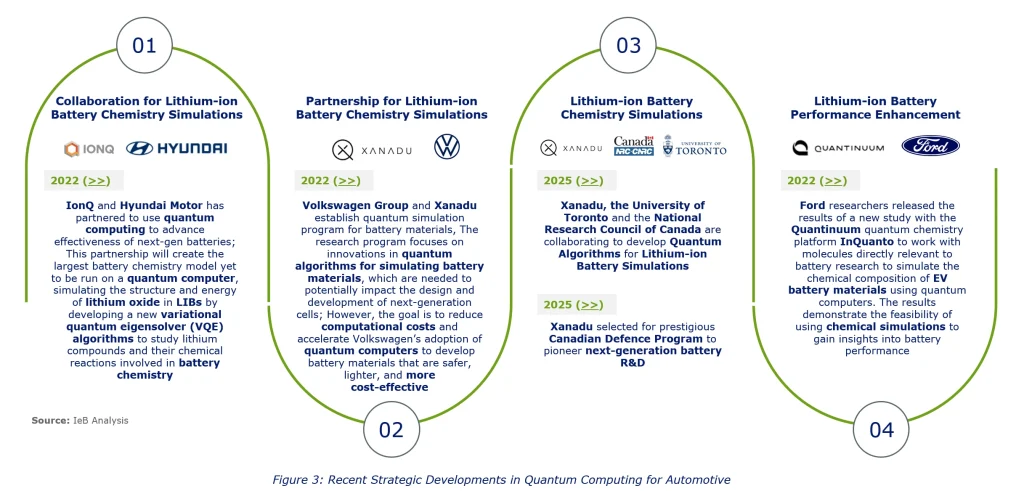
2022: Collaboration for Lithium-ion Battery Chemistry Simulations
Hyundai Motor Company partnered with IonQ to explore the use of quantum computing in advancing next-generation battery performance. The collaboration focused on building one of the largest battery chemistry models executed on a quantum system, specifically simulating the structure and energy states of lithium oxide in lithium-ion batteries.
By leveraging advanced variational quantum eigensolver (VQE) algorithms, the initiative aimed to study lithium compounds and their underlying chemical reactions, an area that remains computationally intensive for classical systems. This marked an important step in validating quantum computing’s potential in complex battery chemistry simulations.
2022: Partnership for Lithium-ion Battery Chemistry Simulations
Volkswagen Group collaborated with Xanadu to establish a dedicated quantum simulation program focused on battery materials. The research initiative centered on developing advanced quantum algorithms capable of simulating complex material behaviors critical to next-generation battery design.
The broader objective was to reduce computational costs and accelerate the adoption of quantum computing in battery R&D, ultimately enabling the development of battery cells that are safer, lighter, and more cost-effective.
2022: Lithium-ion Battery Performance Enhancement
Ford Motor Company, in collaboration with Quantinuum, explored the application of quantum chemistry for improving battery performance. Using the InQuanto quantum chemistry platform, researchers worked with molecules directly relevant to EV battery materials to simulate their chemical composition on quantum systems.
The findings demonstrated the feasibility of using quantum simulations to generate deeper insights into battery behavior, reinforcing the potential of quantum computing as a tool for enhancing material performance and accelerating innovation in electric mobility.
2025: Advancing Quantum Algorithms for Lithium-ion Battery Simulations
Xanadu, in collaboration with the University of Toronto and the National Research Council Canada, is working on the development of advanced quantum algorithms for lithium-ion battery simulations. The focus of this initiative is to improve the precision and efficiency of modeling electrochemical processes, which remain computationally intensive for classical systems.
In parallel, Xanadu has also been selected for a Canadian defence-related program aimed at advancing next-generation battery research and development. This engagement reflects growing recognition of quantum computing as a strategic enabler in high-performance energy systems.
Together, these initiatives highlight a broader shift toward applying quantum computing in practical battery R&D environments, with an emphasis on scalable simulation approaches that can accelerate materials discovery and improve energy storage innovation.
What is the future outlook of quantum computing in automotive?
The long-term trajectory of quantum computing in the automotive sector is expected to be evolutionary rather than disruptive in the near term. Its role will likely emerge as a specialized computational layer that complements classical systems rather than replacing them.
Key anticipated impact areas include:
- Battery innovation and material discovery, enabling faster identification of high-performance chemistries.
- Autonomous driving systems, where quantum models may enhance decision-making under complex variables.
- Manufacturing optimization, particularly in logistics, production sequencing, and cost reduction.
- Advanced simulation of physical systems, improving aerodynamics, crash testing, and vehicle design cycles.
Overall, while full-scale adoption remains a future milestone, early signals suggest quantum computing could significantly compress innovation timelines across electrification and mobility engineering. Building on this trajectory, quantum computing in automotive is now moving through a critical inflection point where exploratory pilots and research collaborations are gradually shaping early industrial use cases, particularly in battery chemistry and advanced materials. Rather than replacing classical systems, it is increasingly being positioned as a complementary computational layer that enhances capability in highly complex problem areas. As the ecosystem continues to mature, the emphasis is expected to shift from validation to scalable application, creating new opportunities across electrification, manufacturing, and mobility innovation.
To explore how these developments could translate into tangible value for your organization, connect with our experts below.