The automotive sector has evolved beyond horsepower and hardware. Today’s vehicles are more towards autonomous driving, software-defined improvements, and interconnectivity via cloud platforms. The next-gen mobility, comprising Vehicle-to-Everything (V2X), over-the-air (OTA) updates release, and autonomous driving algorithms, relies on secure data exchange. As the automotive ecosystem evolves at an incredible rate, quantum key distribution (QKD) is emerging as a key component for the next wave of automotive security to address risks that standard encryption techniques cannot protect against.
But this transformation comes with a growing set of challenges for original equipment manufacturers (OEMs).
Every new layer of connectivity increases the risk of cyberattacks. Vulnerabilities in OTA updates can compromise entire fleets. Breaches of V2X communication can disrupt traffic ecosystems. Backend systems that manage the data from all vehicles have the potential to be significant sources of exposure. Automotive cybersecurity is not simply a backend function; it affects vehicle safety, brand loyalty, compliance with regulations, and recall risk.
Underlying all these increasing complexities is a more profound, underappreciated concern. The cryptographic systems that provide today’s vehicle security were created to meet yesterday’s needs.
Why Is Classical Cryptography Reaching Its Limits?
For decades, automotive cybersecurity has relied on classical cryptographic systems, such as RSA and elliptic curve cryptography (ECC). However, both approaches are robust only against traditional computing attacks and form the backbone of secure communications across industries. But certain mathematical problems are computationally infeasible to solve. And quantum computing challenges those assumptions.
Advances in quantum computing algorithms, especially those capable of factoring large numbers and solving discrete logarithm problems quickly, can potentially render most cryptographic systems currently in use vulnerable. While large-scale quantum computing capability is still in development, the possibility is no longer speculative.
The automotive industry deals with a unique vulnerability due to its extended product life cycle of 10-15 years. Therefore, this creates a major gap between the operating lifetime of a vehicle and the evolution of the cyber threat environment.
A critical risk emerging from this gap is the “harvest now, decrypt later” scenario. Sensitive information exchanged through vehicles, whether about driver behavior, system control parameters, or fleet operation, can be intercepted and stored by attackers. Once quantum computing capabilities mature, that sensitive information can then be retroactively decrypted.
In other words, even if current systems appear secure, they may already be compromised in the long term.
For OEMs, this is not just a cybersecurity issue. It is a strategic risk that affects product integrity, customer trust, and long-term liability.
Where Quantum Key Distribution Fits in the Automotive Ecosystem?
Quantum key distribution (QKD) introduces a fundamentally different approach to securing communications. Instead of relying solely on mathematical complexity, it uses the principles of quantum mechanics to enable secure key exchange. Any attempt to intercept or eavesdrop on the key alters its quantum state, making intrusion immediately detectable.
From a broad perspective, QKD is not necessarily intended to embed quantum hardware within each vehicle. Rather, it serves to strengthen the overall mobility ecosystem in terms of providing a high degree of assurance in respect to securing the data flowing across critical areas of interaction.
Within automotive, one area that appears highly relevant is V2X communication. When vehicles are interacting with various forms of infrastructure, traffic systems, and/or other vehicles, ensuring the integrity and confidentiality of data exchanges between vehicles and infrastructure are paramount. QKD can strengthen the security of the key distribution layer underlying V2X communication, thereby minimizing the risk of either manipulation or interception.
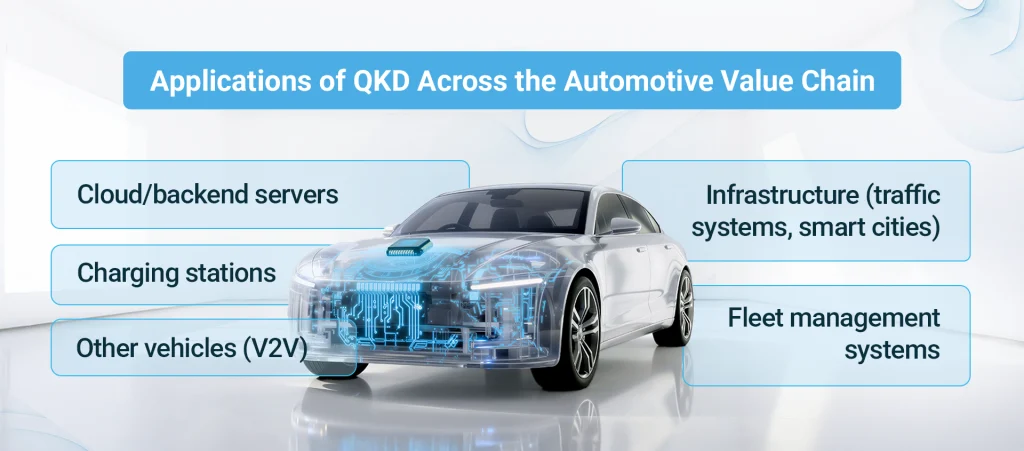
Autonomous driving systems also stand to benefit. These systems rely on continuous data exchange between sensors, edge devices, and cloud-based platforms. Ensuring the confidentiality of data exchanged in this manner is necessary since any loss of trust or integrity would negatively affect decision-making at the vehicle level. Securely distributing keys using quantum key distribution (QKD) increases the level of trust associated with exchanging data between these entities.
In addition to V2X communication and autonomous driving systems, OTA updates also offer opportunities to utilize QKD. Since OTA updates are at the core of the concept of software-defined vehicles, they represent a significant source of vulnerability. By utilizing QKD to secure the encryption keys utilized in firmware updates, OTA updates can prevent both unauthorized access to firmware and subsequent tampering.
On a larger scale, QKD also offers solutions for fleet and backend security. Data exchanged between vehicles and cloud-based infrastructure, representing everything, from diagnostic-related data to user data, can be secured using QKD-enabled quantum-secured key distribution. This is particularly important for large-scale fleet operations, where a single breach could have widespread consequences.
In essence, QKD integrates into the key management layer of the automotive stack. QKD does not replace existing systems — instead, it strengthens the base-layer security architecture, from which secure communication occurs.
Automotive Industry Momentum: Early Signals and Strategic Moves
Although quantum key distribution (QKD) in automotive is still in its emerging phases, a sense of direction is becoming clear.
Telecommunications companies, quantum technology companies, automotive OEMs, and other stakeholders are establishing pilot programs focused on creating the framework for incorporating quantum-secure communication into automotive ecosystems. These efforts typically involve ensuring secure transmission of data between vehicles and infrastructure or ensuring secure backend communication using quantum-protected protocols.
Additionally, smart cities are accelerating adoption. As urban mobility systems are expanding, there is an increasing demand for large-scale secure communication networks that leverage quantum technologies, including QKD, to meet those demands.
Governments worldwide are investing significantly in quantum research and infrastructure development. Unlike purely exploratory investments in core research, many government-backed investment initiatives are targeted toward practical application in transportation and critical infrastructure protection.
For the automotive sector, these developments signal a shift. QKD is moving from conceptual research to practical experimentation. The ecosystem required to support it, spanning telecom networks, quantum hardware, and cybersecurity frameworks, is beginning to take shape.
The implication is clear: early movers are not just testing technology; they are shaping the standards and partnerships that will define future deployment.