

More than 5,000 SEP declarations exist globally, yet only around 25–35% of declared 5G patent families are estimated to be truly essential, clearly showing how the commercial value of Standard Essential Patents (SEPs) varies across technologies such as 3G, 4G, 5G, 6G, Wi-Fi, video coding, IoT, and connected systems.
This is where most companies struggle to identify:
• Which patents are truly essential to a standard?
• Which ones are strong enough to license or enforce?
• And which patents actually give you leverage when you’re sitting across the table in a negotiation?
In practice, a focused set of high-quality SEPs drives licensing discussions, enforcement strategies, and real commercial outcomes. Without that clarity, portfolios can quickly lose direction. You may end up over-declaring SEPs, relying on claim charts that don’t hold up under scrutiny, or missing out on real licensing and monetization opportunities.
At Ingenious e-Brain, our Standard Essential Patent (SEP) analysis services go beyond basic standards mapping. Through a mix of standard intelligence & expertise, data-backed analysis, and litigation-grade claim charting, we identify the patents that can stand their ground and explain exactly why they truly matter.
Our SEP services are tailored for real-world decision-making in complex standards-driven ecosystems. Most organizations deal with: large patent portfolios where actual value is hard to isolate, unclear essentiality that creates licensing and enforcement risk, claim charts that are difficult to defend under scrutiny, and a growing disconnect between standards participation and business strategy.
We simplify this by turning detailed standards, technical specifications, and patent data into insights you can actually use, so you’re not second-guessing your position, whether it’s in licensing, negotiations, or litigation.
Our approach helps you clearly filter and deeply analyze your SEP portfolio with precision, whether you’re working on FRAND (Fair, Reasonable, and Non-Discriminatory) licensing, validating declared SEPs, strengthening your position in negotiations, benchmarking competitors, or getting prepared for possible litigation.
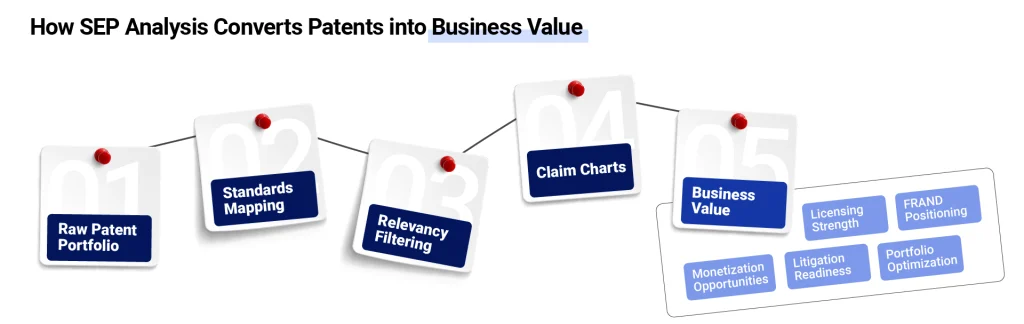
• Ensure SEP analysis is closely aligned with business priorities including licensing, portfolio strengthening, readiness for assertion, managing risk, or supporting acquisitions.
• Identify which standards ecosystems are applicable (e.g. 3GPP, Wi-Fi Alliance, ETSI); what version(s) of those ecosystems are being evaluated; what domain(s) of technology are applicable.
• Define the analysis universe (e.g. the target portfolio, SEPs you have declared, patents you wish to include in the evaluation, and competitive landscape).
• Conduct ETSI dynamic reporting and standards database evaluation of the relevant standards and technical domains.
• Map patents to specifications, releases, working groups, and technical contributions made to the development of a standard.
• Develop backward and forward traceability using standards documents, meeting records, archival data, and meeting records to reconstruct standards development over time.
Assess each candidate patent across these 3 strategic dimensions:
• Detectability: understand how easily we can map claim elements can be mapped to the standard, or whether reverse engineering would be required.
• Claim Strength: check the breadth of the claims along with their structural robustness/resilience.
• Business Impact: evaluate the relevance of candidate patents to core implementations, flagship products, and overall coverage in the marketplace.
• Determine legal robustness, commercial relevance, and feasibility of mapping candidate patents to existing standards.
• Classify patents into Most Relevant, Relevant, or Not Relevant depending upon their SEP potential and value.
• Develop structured claim charts that map shortlisted patents directly to the relevant standards.
• Map claims with core standards and conformance specifications to strengthen the mapping (wherever applicable).
• Build supporting evidence packs that can be used in supporting licensing discussions, negotiations, or litigation.
• As per the requirement, extend this analysis to product-level EoU-style analysis.
Each chart is created to be defensible, review-proof, and ready for negotiation.
Analyse how each SEP strengthens by:
• Licensing and FRAND negotiation positions
• Competitive and implementer leverage
• Protection of key market positions
• Signaling of the technology leadership in the standard
This phase helps technical essentiality transform into business strategy.
Deliver a consolidated decision-ready SEP intelligence package that includes:
• A prioritized list of SEPs ranked by relevance.
• Detailed, well-structured claim charts.
• Strategic insights on prioritization.
• Portfolio-wide recommendations for acquiring/asserting/licensing/pruning.

Deep hands-on experience across 3GPP (3G, 4G, 5G, 6G, NR), Wi-Fi, Video Coding, and other ICT standards ecosystems.

Defensible claim charts designed for real-world scrutiny

We offer tailored pricing models to fit every budget with fast turnaround times as per project requirements.

Equipped with a team of 120+ PhDs and SMEs bringing deep technical and legal expertise across ICT domains.

Ability for native language searching within 25+ countries, including China, Japan, Korea, etc., along with regional databases for accurate native language search results.

Interconvertible and easy-to-digest reports with claim element grid mapping to speed up your decisions.

Hybrid search methodology by combining Artificial Intelligence + Human Intelligence to deliver accurate, relevant results.

Search teams based in the US and India, operating under export control compliance frameworks.
Multi-layered firewalls and stringent access controls to ensure full data confidentiality and compliance.
Our services are designed to support enterprises within the below mentioned industries and sectors, helping them achieve their strategic goals.
SEP analysis evaluates whether a patent is essential to a standard and assesses its strength, relevance, and business value.
No. We also identify undeclared SEPs hidden inside portfolios.
Yes. Our SEP analysis and charts are designed specifically for licensing & negotiation contexts.
Yes. We often extend SEP charts into product-level mapping when needed.
3GPP (3G, 4G, 5G, 6G, NR), Wi-Fi, video coding, and other major ICT standards.
Absolutely. Our process is built for both single-asset deep dives and portfolio-scale programs.
A rare combination of standards depth, business prioritization, and litigation-grade execution.