
Germany is known for its engineering excellence, process discipline, and innovation capabilities. Over the decades, this mastery, cultivated by German companies, has powered advancements in machinery technology, automotive systems, industrial solutions, and software-enabled products. Today, this foundation is increasingly being extended through German Mittelstand expansion in India, as firms look beyond domestic markets to scale innovation and global competitiveness.
However, in an era of rapidly evolving markets, intensifying global competition, and accelerating technology cycles, sustaining leadership demands more than incremental change. German Mittelstand expansion in India is increasingly shaped by strategic geographic diversification. To continue innovating at scale, attract diverse talent, and capture emerging growth opportunities, Mittelstand firms are extending their international footprint, particularly into India and other markets where technological expertise can combine with local scale, talent, and ecosystem support to create globally competitive offerings.
The Hidden Frictions of Scaling Global Excellence for German SMEs
Even for the German Mittelstand, globally respected for engineering excellence, precision, and long-term entrepreneurial vision, international expansion is not a disruption, but a natural next stage of evolution. The challenge lies not in acquiring new capabilities, but in elevating existing strengths so they can create impact across borders. Those who succeed in scaling proven excellence internationally turn complexity into growth and experience into sustainable global success.
As German Mittelstand expansion accelerates, key friction points are becoming visible, highlighting where focused leadership and scalable structures can unlock the next level of international performance.
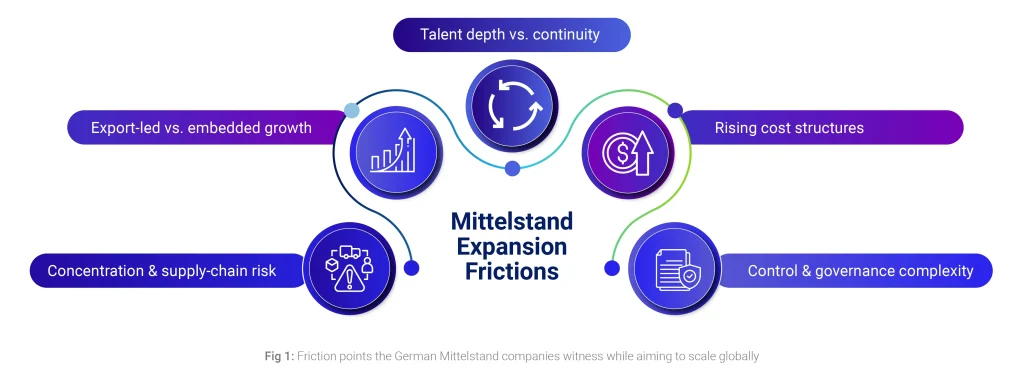
Talent depth versus talent continuity
Germany remains a global benchmark for engineering quality, yet the availability of specialized skills in areas such as machine manufacturing, automotive software, industrial automation, electronics, and AI is tightening. As product lifecycles shorten and software content rises, relying only on domestic talent pools can slow development velocity and stretch internal teams, particularly for mid-sized firms competing with larger global players for the same expertise.
Cost structures under innovation pressure
Sustaining advanced R&D, high-mix manufacturing, and customer-specific engineering in Europe continues to deliver quality, but at rising cost. Energy prices, wage inflation, and regulatory overhead are forcing difficult trade-offs between margin protection and continued investment in next-generation capabilities.
Scaling without losing control
Mittelstand firms excel in tightly managed, relationship-driven environments. Replicating this level of control across new geographies is challenging. Fragmented supplier ecosystems, varying compliance regimes, and uneven execution standards can dilute quality and slow scale-up unless supported by strong governance and local insight.
From export-led to market-embedded growth
Many German SMEs initially enter new markets through exports or distributor-led models. Over time, this approach can limit customer proximity, slow localization, and restrict learning. As Asian markets increasingly demand faster customization, local engineering input, and shorter response cycles, firms face growing pressure to embed themselves more deeply in target markets.
Concentration risk in global footprints
Dependence on a small number of production or sourcing locations has exposed vulnerabilities in recent years. Supply chain disruptions, geopolitical shifts, and energy volatility have made geographic diversification not only a growth lever but a resilience requirement.
Taken together, these challenges highlight a clear strategic imperative. Future-ready expansion must move beyond sales presence or cost arbitrage alone. German Mittelstand firms increasingly need geographies that support scalable innovation, operational resilience, access to talent, and ecosystem integration, while preserving the standards that define their global reputation.
Why India Is Becoming Core to German Mittelstand Expansion
India is no longer entering the global conversation as an emerging market; instead, it is stepping into the role of a strategic innovation hub & operating base for German Mittelstand companies. What is driving this shift is not a single advantage, but the alignment of market scale, technical talent, policy support, and infrastructure readiness. Together, these factors make India increasingly relevant for both production and high-value engineering work.
Cost, Talent, and Scalable Capability
India offers one of the world’s largest pools of engineering and digital talent, supporting R&D, product engineering, and software-driven innovation at scale. German firms are able to build dedicated engineering and design teams that work closely with headquarters on embedded software, automation, and product customization.
Beyond major metros, cities such as Indore, Pune, and Coimbatore are emerging as credible technology and manufacturing hubs. These locations combine lower operating costs with improving academic and industrial ecosystems, enabling Mittelstand companies to scale operations faster while maintaining quality and continuity.
Policy & Incentives That Strengthen the Business Case
India’s industrial policy has shifted toward targeted, execution-focused schemes that matter for technology-intensive SMEs. Production Linked Incentive programs across electronics, automotive, and EV components, pharmaceuticals, and advanced chemistry improve the economics of export-oriented manufacturing.
In parallel, state-level incentives such as capital subsidies, R&D benefits, and concessions on land and power reduce entry barriers. For Mittelstand firms, the value lies in clearer, time-bound incentives that can be incorporated into long-term investment planning rather than treated as optional upside.
Infrastructure That Enables Global Reach
Industrial corridors such as Delhi, Mumbai, Chennai, and Bengaluru are integrating manufacturing zones with ports, highways, and freight rail, supporting cost-efficient and predictable logistics. Multimodal logistics parks and increasingly digital customs processes are reducing clearance times and handling costs.
As a result, India is becoming viable not only as a production base for the domestic market, but as a regional and global export platform within German companies’ Asia strategies. For companies navigating the next phase of German Mittelstand Expansion, India offers a rare combination: scale without strategic compromise.
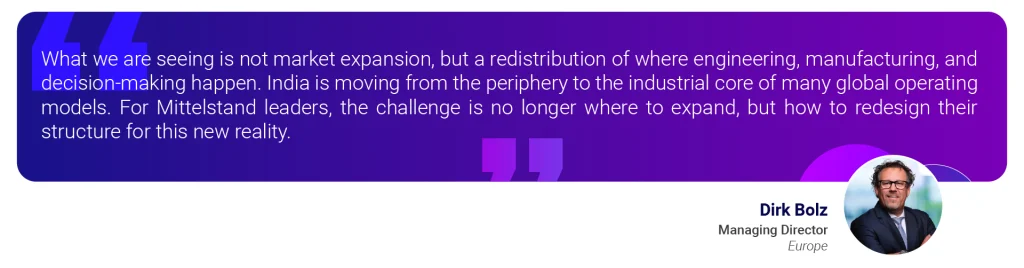
German Mittelstand–India Engagement: The Last Five Years in Perspective
Over the past five years, the relationship between German Mittelstand companies and India has shifted from cautious exploration to confident, multi-dimensional engagement. While there is no single public dataset that captures the exact number of Mittelstand firms active in India between 2021 and 2026, multiple strong proxies point to a clear conclusion: hundreds of German mid-sized companies are now actively trading, investing, or operating in the Indian market, and the momentum is still building.
Strategic Partnerships
What is particularly telling is the sharp rise in structured, long-term commitments. More than 500 joint ventures now link German Mittelstand firms with Indian partners, particularly in the automotive, industrial engineering, chemicals, machinery, and renewable energy sectors. These partnerships are not just about market access; they are increasingly about co-development, localized production, and R&D.
Make in India Mittelstand (MIIM)
Programs like Make in India Mittelstand (MIIM) offer another strong signal. As of 2024, the initiative has supported 174+ companies (with recent counts touching ~218), driving over €1.5 billion in investments, creating more than 46 operational facilities and over 1,200 jobs. This reflects a shift from “export-first” to “build-in-India” strategies.
Chamber Engagement and Bilateral Trade Momentum
Chamber engagement tells a similar story. The Indo-German Chamber of Commerce (AHK / IGCC) today counts 4,000–6,000 member companies, predominantly Mittelstand, actively participating in bilateral trade, with annual trade exceeding €25 billion. Surveys consistently show strong forward intent: 53–79% of German companies plan further investments in India over the next five years, driven primarily by market access and by India’s emergence as a production and innovation hub.
Innovation Nodes
Perhaps the most striking trend is in Global Capability Centers (GCCs) and engineering hubs, where Mittelstand participation has more than doubled in recent years, signaling a strategic pivot toward India not just as a cost base, but as a core node in global innovation and product development.
As global supply chains are being reimagined and industries prepare for their next big transformation, the recent Indo-German relationship is amongst the few partnerships beginning to stand out as true builders of the future.

What was once a largely trade- and investment-led engagement is now turning into a strategic industrial alliance. German Chancellor Friedrich Merz’s official visit to India in January 2026 highlights the shared ambition to co-create future industrial systems related to semiconductors, defence manufacturing, critical minerals, digital infrastructure, and clean energy. More than collaboration, this marks a quiet rewiring of global value chains. Instead of optimizing within existing structures, both countries are beginning to co-design where engineering, manufacturing, and system integration should live. The result is a new Indo-European industrial backbone that is being built by intent, not by accident.
Blending Indian Execution with German Strategy
For many German Mittelstand companies, the first India entry often begins with a clear strategic blueprint shaped in Europe. The real learning, however, starts once that strategy meets the realities of operating on Indian ground. Success comes not from rigid replication but from thoughtful integration, in which German engineering discipline is adapted to local conditions without losing its core strengths.
Regulation as a strategic design choice
One common early realization for German firms is that India does not operate as a single regulatory market. A manufacturing project that progresses smoothly in one state may face longer approval cycles in another. Companies that perform well tend to treat regulatory planning as part of strategic design rather than a back-office task. By engaging state investment agencies early and selecting industrial parks with pre-cleared land and utilities, several Mittelstand manufacturers have been able to compress setup timelines and align investment phasing with global rollout plans.
Suppliers that grow with the strategy
In many cases, the first generation of local suppliers may not immediately meet German quality or documentation standards. Rather than switching partners repeatedly, successful firms often invest in shaping the ecosystem. Examples from automotive and industrial components show that German SMEs work closely with Indian suppliers to implement process controls, quality audits, and continuous improvement routines. Over time, these suppliers evolve into reliable partners that support not just India operations but also global export programs.
When speed meets structure on the shop floor and in R&D
Indian teams are often quick to improvise solutions when faced with design changes or production challenges. This agility becomes a strength when paired with clear governance. In several Indo-German engineering centers, companies have introduced lightweight but rigorous documentation frameworks that preserve flexibility while ensuring traceability and compliance. The result is faster iteration cycles without compromising the quality benchmarks expected by headquarters and global customers.
Decision-making beyond the org chart
German managers are sometimes surprised to find that progress in India depends less on formal reporting lines and more on relationships across functions and hierarchies. Projects tend to move faster when companies invest time in stakeholder mapping and regular multi-level engagement, from plant leadership to local authorities and ecosystem partners. Firms that recognize this early often report fewer delays and smoother coordination as operations scale.
Culture as a multiplier, not a hurdle
The strongest Indo-German operations are those where cultural differences are deliberately harnessed. German structure, planning discipline, and technical depth combine with India’s execution speed, digital fluency, and problem-solving mindset. Companies that formalize this blend through joint leadership teams, shared performance metrics, and cross-cultural training often see higher employee engagement and faster capability buildup.
Successful German Mittelstand Expansion in India comes not from rigid replication, but from thoughtful integration, where German engineering discipline adapts to local conditions without losing its core strengths.
Forward Signals Positioning India as the New Center for Investment & Innovation
India is evolving as a compelling hub for German and global supply chains, as validated by multiple public sources highlighting its growing role in manufacturing, innovation, and services. Across investment, workforce, policy, and supply-chain dynamics, India is proving to be more than a “China+1” alternative; it is becoming a strategic anchor for long-term growth.
German investment and the hub potential
Approximately 2,000 German companies are currently active in India, making Germany one of India’s top ten foreign investors. >> This reflects a long-term commitment to India as both a production base and an engineering hub. Cooperation reports from the Confederation of Indian Industry (CII) show that German firms increasingly leverage India not only for local manufacturing but also as a global competence center, with a growing share planning India-based production for regional and international markets by 2029.
Supply-chain diversification and China+1 strategies
Rising costs and regulatory risks in China, coupled with geopolitical tensions and trade frictions, are driving global multinationals to diversify supply chains. Gateway House describes India as a complementary Asian manufacturing hub that enables the “China plus one” approach. Academic analyses reinforce this trend, highlighting India’s resilient supply chains and scale as key drivers for relocation of higher-value manufacturing and services.
Political stability and predictable policies
India’s sustained economic growth, improving ease of doing business, and continuity in reform-oriented policies create a relatively predictable macro and policy environment. India–Germany cooperation briefs further emphasize India’s participation in EU partnerships on green energy, mobility, and digitalization, offering German companies opportunities for long-horizon industrial collaboration.
For leaders shaping the next decade of German Mittelstand Expansion, these signals reinforce India’s role as a durable center for manufacturing, innovation, and global delivery.
Strategic Recommendations for German Mittelstand Expansion
For German Mittelstand companies, India is no longer a tactical expansion option. It is a strategic lever for growth, resilience, and long-term competitiveness. Firms that succeed are those that integrate India deliberately into their global operating model, with clear intent, governance, and investment discipline.
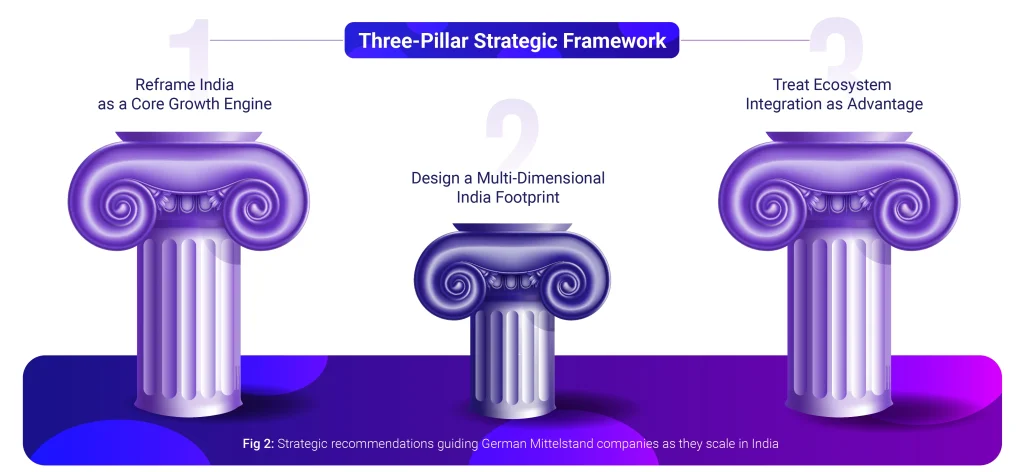
Reframe India as a Core Growth Engine, Not an Optional Market
India delivers its full value only when it is treated as a structural pillar in global industrial electronics and software-enabled products; this requires moving India from a regional initiative to a board-level strategic priority.
In advanced German Mittelstand expansion strategies, India’s role is clearly articulated across growth, innovation, and supply-chain resilience over a 5–10 year horizon. This includes defining clear investment corridors, capability-building milestones, and risk frameworks that enable firms to absorb early complexity while compounding their advantage over time. Companies that delay this reframing often remain stuck in pilot mode, underutilizing India’s scale and strategic depth.
Design a Multi-Dimensional India Footprint
Single-function India setups rarely unlock strategic advantage. Firms that outperform typically design India as a multi-role platform that supports several parts of the value chain simultaneously.
This includes production facilities serving both domestic and broader Asian markets, engineering and R&D centers focused on localization, software, and embedded systems, and shared services or global capability centers (GCC) handling finance, analytics, procurement, and customer operations. Increasingly, leading firms also invest in innovation labs or structured partnerships with universities and startups in areas such as automation, AI, electrification, and sustainability.
This multi-dimensional design is becoming a defining feature of resilient German Mittelstand Expansion, offering optionality as markets, technologies, and cost structures evolve.
Treat Ecosystem Integration as a Source of Competitive Advantage
In India, execution strength is inseparable from ecosystem depth. Mittelstand companies that view suppliers, institutions, and talent networks as strategic assets rather than transactional inputs tend to scale faster and operate with lower risk.
This involves long-term supplier development to embed quality systems and process discipline, active participation in industry clusters and chambers to anticipate regulatory shifts, and sustained engagement with state agencies to align incentives and infrastructure with growth plans. Talent strategies that link universities, technical institutes, and in-house training to German engineering standards further strengthen this ecosystem advantage.
Companies that embed ecosystem thinking early in their German Mittelstand Expansion often find that complexity becomes a competitive differentiator rather than a constraint.
How Ingenious e-Brain Supports Mittelstand Expansion into India
For German Mittelstand companies, the real challenge is not deciding whether India matters, but how to translate strategic intent into on-the-ground execution without losing control, quality, or momentum. This is where clarity, local insight, and disciplined execution make the difference between pilot initiatives and scalable impact.
Ingenious e-Brain supports German Mittelstand Expansion through a 4-Phase India Expansion Framework to help German companies explore the Indian region and transform it from a complex market into a structured growth platform by:
- Delivering tailored, data-backed insights to define India’s role as a production base, engineering hub, and innovation engine within the global operating model.
- Supporting the end-to-end establishment of manufacturing units, from site selection and incentive mapping to alignment with central and state-level regulatory frameworks.
- Identifying, evaluating, and developing suppliers and strategic partners to build resilient, quality-assured value chains aligned with German engineering standards.
- Enabling targeted technology adoption and digital transformation across manufacturing, engineering, and operations to improve productivity, transparency, and scalability.
- Accelerating product localization and development for Indian and global markets, reducing cost and time-to-market while preserving engineering integrity.
- Designing tailored operating models that balance speed, cost efficiency, and governance, ensuring long-term scalability rather than short-term arbitrage.
The goal is simple but ambitious: helping Mittelstand companies build an India footprint that strengthens competitiveness today while compounding strategic advantage for the decade ahead.